The Ankle Pain Trigger Points
First, I need to offer some clarification about the various terms used for naming this muscle group. Some people use the name peroneus and some use the name fibularis (newer) for the muscles in this group. Some people use the term peronii for the plural representation of these muscles, while other people use the terms peronei or peroneal. I typically use the terms peronii or peroneus, but you may see these other variations in my writing.
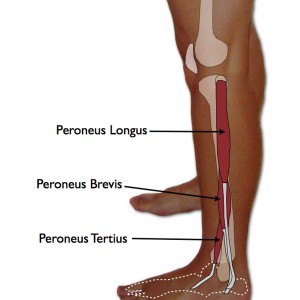 Trigger points in the peroneus muscles of the lower leg are a common, but relatively unknown, source of ankle pain and weakness. People who suffer from frequent and reoccurring ankle sprains are likely to have chronic peronii trigger points perpetuating this condition.
It is very common for the ankle pain and tenderness produced by these trigger points to be mistaken for ankle joint pain itself (coming from damaged ligaments and the joint capsule). If ankle pain persists after an ankle sprain or fracture has healed, you can bet that these trigger points are responsible for it. If left untreated, these trigger points will also cause the ankle to be very weak and unstable, making it all-the-more susceptible to future sprains.
The Peroneus (Fibularis) Muscles
Location: The peronii muscle group lies on the outside of the lower leg and is composed of three muscles: the peroneus longus, the peroneus brevis, and the peroneus tertius.
Function: In everyday activity, the peronii muscles act to control the balance and placement of the body weight on the planted foot during walking and running.
Muscle Structure: The three components of the peronii muscle group are detailed below:
- The peroneus longus muscle is the most superficial muscle in the lateral compartment of the leg. It originates on the fibular head and along the outside of the upper half of the fibula bone. The muscle extends down the outside of the lower leg and becomes a tendon about half-way down the leg. The peroneus longus tendon wraps around behind the lateral malleolus (ankle bone) and under the sole of the foot to attach to the first metatarsal bone.
- The peroneus brevis lies partially underneath the peroneus longus. It originates along the bottom half of the fibula bone and its tendon travels with the peroneus longus tendon behind the lateral malleolus to attach to the fifth metatarsal bone on the sole of the foot.
- The peroneus tertius lies in the anterior compartment of the leg with the tibialis anterior muscle. It originates along the front of the lower fibula bone and its tendon wraps around the front of the lateral malleolus to attach to the forth and fifth metatarsals on the sole of the foot.
Muscle Actions: All three muscles act to evert or pronate (turn the sole of the foot outwards slightly) the foot at the ankle. Additionally:
- Contraction of both the peroneus longus and peroneus brevis also produces plantar flexion (pushing down) of the foot at the ankle.
- Contraction of the peroneus tertius also produces dorsiflexion (lifting) of the foot at the ankle.
Synergistic Muscle Groups: The following muscles share similar biomechanical functionality with the peronii muscles and may become overloaded if they are unable to perform their workload due to trigger point activity or injury:
- The toe extensor muscle (extensor digitorum longus) assist all three peronii muscles in everting the foot.
- The peroneus longus and brevis assist gastrocnemius, soleus, and tibialis posterior in plantar flexion of the foot.
- The peroneus tertius assists the tibialis anterior in dorsiflexion of the foot.
Antagonistic Muscle Groups: The following muscles oppose the movement produced by the peronii and may develop trigger point activity in response to abnormal neuromuscular tone and contractile capacity.
- The tibialis anterior and tibialis posterior oppose the eversion of the foot produced by all three peronii muscles.
- The plantar flexion produced by the peroneus longus and peroneus brevis is opposed by the tibialis anterior, peroneus tertius, and toe extensor muscles, which dorsiflex the foot.
The Peroneus (Fibularis) Trigger Points
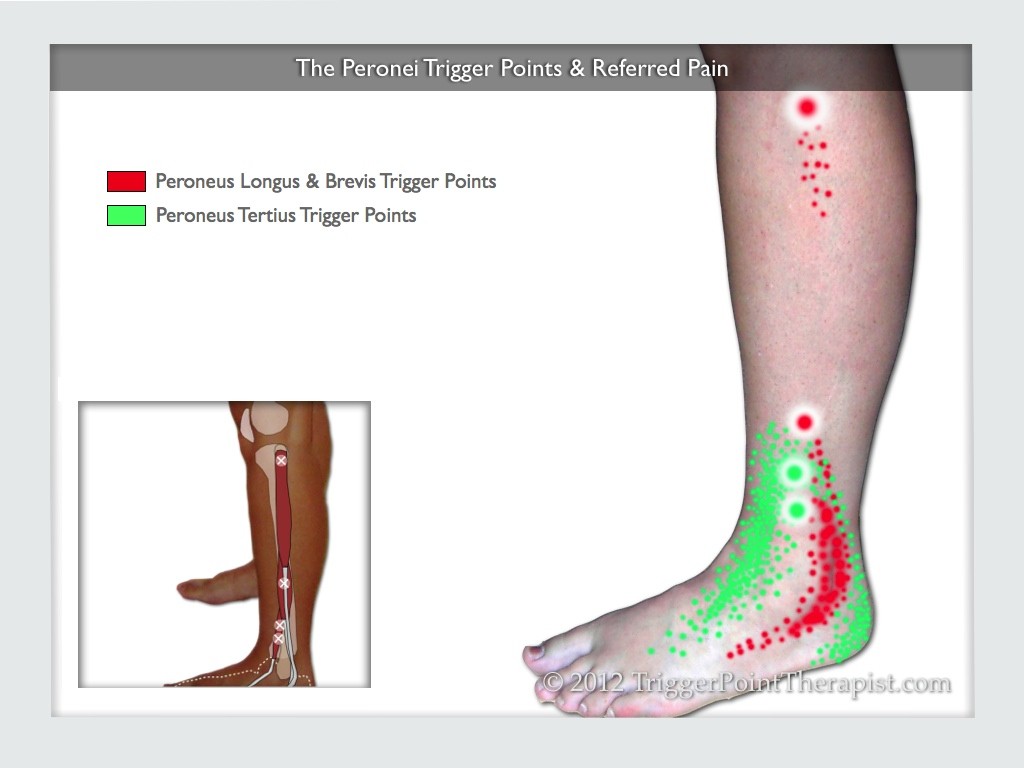
Trigger Point Locations: As shown in the diagram below, the peronii muscle group can contains up to four trigger points:
- The peroneus longus trigger point is found just a few inches below the muscle’s attachment to the fibular head.
- The peroneus brevis trigger point is found in the same vertical plane as the peroneus longus trigger point, but farther down the leg towards the lateral malleolus.
- The two peroneus tertius trigger points are found just above and a little in front of the lateral malleolus.
Peroneus (Fibularis) Pain
The diagram above also shows the referred pain patterns associated with the peronii trigger points.
- The peroneus longus and peroneus brevis trigger points both refer pain and tenderness to the outside of the ankle, focusing on the lateral malleolus. The pain may spillover into the outside of the foot and sometimes up into the outside of the lower leg.
- The peroneus tertius trigger points project pain to the front of the ankle with spillover to the outside of the heel and behind the lateral malleolus.
Peroneus Trigger Point Symptoms & Findings
Clients with active peronii trigger points will present with any or all of the following symptoms or clinical findings:
- Weak or unstable ankles that sprain easily and frequently.
- Pain and tenderness on the outside of the ankle, in and around the lateral malleolus (outside ankle bone) region.
- Pain and tenderness may also be experienced on the front of the ankle.
- A history of ankle fractures.
- Foot drop: client may be unable to lift their foot properly while walking, causing it to drag behind. This may occur if there is an active trigger point in the tibialis anterior muscle, or if the deep peroneal nerve is entrapped by tight peroneus longus and brevis muscles.
- A side-to-side rocking (with or without pronation) of the foot may be observed while the client is walking.
- Muscle Weakness Test: with the client face-up on a table, the therapist places the palm of their right hand on the sole of the client’s right foot (or vice-versa) and turns the sole of the client’s foot to the outside (eversion or pronation of the foot). The client is then asked to plantar flex (push) their foot against the therapist’s hand who attempts to match the pressure. Be sure that the clients toes are relaxed and that their foot is everted as the client pushes against your resistance. Weakness of the peronii should cause the client’s push to give away after a few seconds.
What Causes Peroneus Trigger Points?
The following events or activities may activate or reactivate the peronii trigger points:
- An inversion sprain of the ankle is likely to overload the peroneus longus and brevis muscles.
- Prolonged immobilization of the ankle with a cast or brace can weaken all three peronii muscles.
- Sleeping with the foot plantar flexed (bent down) because of a heavy blanket or from sleeping on the stomach can shorten the peronii (and calf) muscles causing them to develop trigger point activity.
- Wearing high heels for a long period of time can activate trigger points in the peronii and other muscles of the lower leg.
- Walking, hiking, or running over uneven or rough ground can overload the peronii muscles.
- A Morton foot structure can destabilize the foot and perpetuate trigger points in the peronii and tibialis muscles (more information below).
- Having flat feet and/or wearing shoes that don’t support the arch of the foot (like sandals) will predispose a person to peronii trigger point activity.
- Wearing long socks or a garter that has a tight band around the lower leg may physically irritate the trigger points in the peroneus longus and brevis muscles.
Related Disorders
- Lateral Compartment Syndrome: A serious condition typically caused from over-exercise and/or a muscle tear that is characterized by diffuse pain and swelling in the outside of the lower leg. Typically seen in runners that over-pronate their feet while running, anyone suspected of having this condition should be referred out for testing of the pressure in the lateral compartment of the leg to confirm the diagnosis immediately.
- Morton’s Foot Structure: A variation of the boney structure of the foot where the base of the second toe (next to the big toe) is farther forward than the base of the big toe. Typically, a thick callus forms on the foot where the second toe attaches to it. This condition causes side-to-side instability in the foot which can overload the muscles that act to stabilize the foot, such as the peroneal and tibial muscle groups.
- Ankle Joint Sprain or Arthritis: Ankle pain may be the result of a sprain or tear of the lateral ligaments and/or joint capsule of the ankle. Chronic ankle pain may also result from arthritis in the ankle joint.
- Common Peroneal Nerve Entrapment: A tight peroneus longus muscle may compress the common peroneal nerve where it passes by the fibular head. Compression of this nerve may affect both the superficial and deep peroneal nerves that branch off of it, weakening both the peronii and tibialis muscles groups and causing a small triangular patch of numbness on the top of the foot between the big toe and the second toe.
- Deep Peroneal Nerve Entrapment: The deep peroneal nerve, which branches off the common peroneal nerve, can be compressed by either a tight peroneus longus muscle or a tight toe extensor muscle (as it enters the anterior compartment of the lower leg). This nerve controls the peroneus tertius, tibialis anterior, and toe extensor muscles found in the anterior compartment of the lower leg. Compression of this nerve can weaken these muscles dramatically, causing a serious case of foot drop.
Treatment of Peroneus Trigger Points
Please purchase the Trigger Point Therapy for Peronii Video + 18-page PDF Booklet to learn how to locate and release these trigger points.
You can watch a sample from the Peroneus Trigger Points video on YouTube by clicking on the video image below:

Related Articles:
- Tibialis Anterior Trigger Point: The Foot Drop Trigger Point
- Tibialis Posterior Trigger Point: Sneaky Achilles Tendonitis
Related Instructional Videos:



More Links & Information:
- Myofascial pain and dysfunction: the trigger point manual – Google Books Result
- A Podiatrist’s Guide to Trigger Points & Myofascial Pain Syndrome
- Trigger points that cause ankle pain and ankle weakness
- Peronius Brevis-Ankle Pain-Trigger Points
- The Trigger Point Therapy Workbook: Your Self-Treatment Guide for … – Google Books Result
- Peroneus longus – Wikipedia
- Peroneus brevis – Wikipedia
- Peroneus tertius – Wikipedia